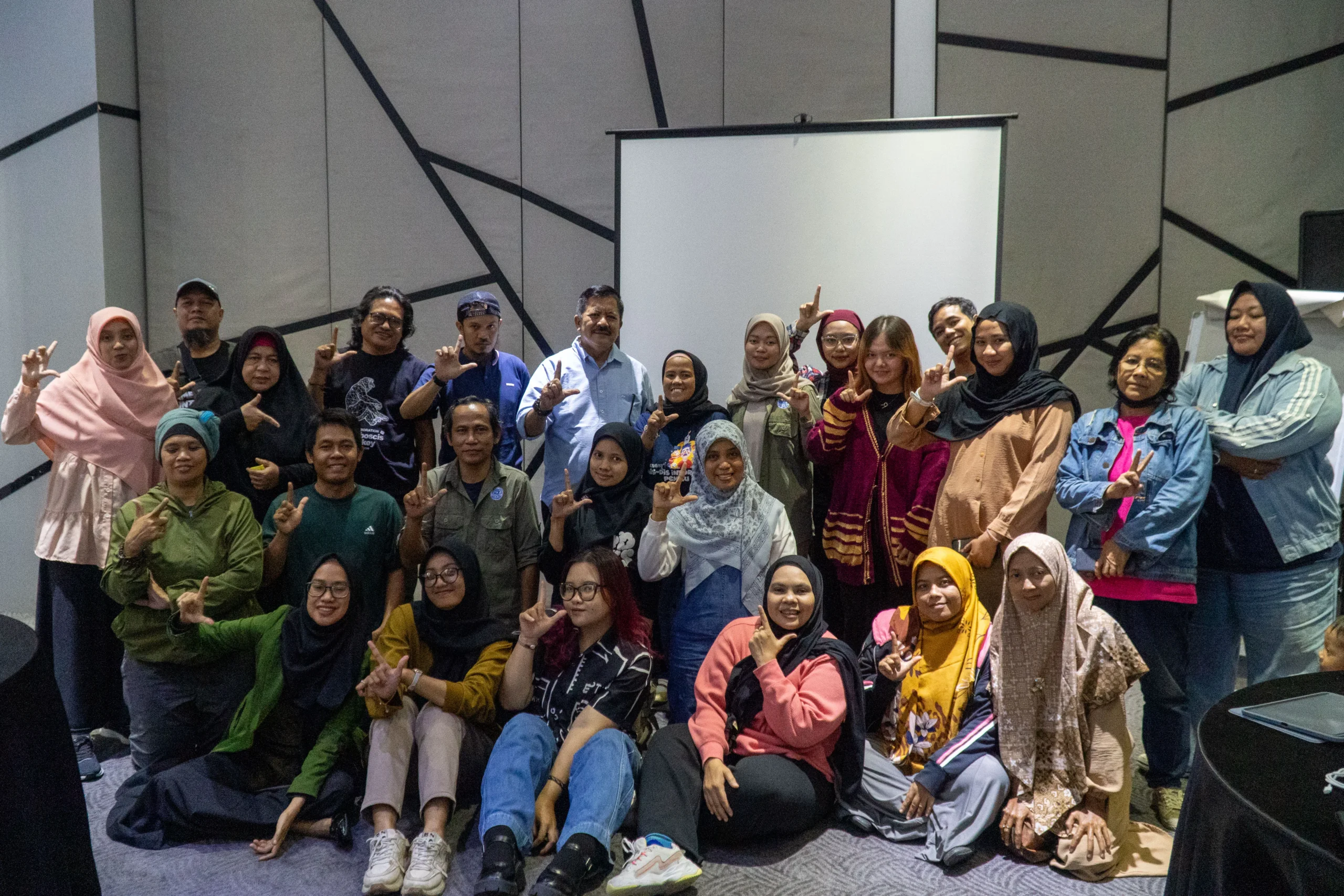
Environmental and sustainability issues are now getting more attention, especially in the midst of the rampant exploitation of Natural Resources (SDA) that have a direct impact on ecosystems and people’s lives. To help encourage the role of the media in raising these important issues, Yayasan Initiasi Alam Rehabilitasi Indonesia (YIARI) together with Khatulistiwa women journalists (JPK) held a writing workshop at Hotel Neo, Pontianak, towards the end of 2024.
The workshop is designed to strengthen journalists ‘ ability to cover environmental topics in greater depth and meaning. Participants are also equipped with an understanding of the management and conservation of natural resources, plus writing training so that the results of their coverage are sharper, informative, and have a real impact on the community.
“Maybe you’ve seen videos of orangutans who are confused about looking for a place to live because their habitat has been damaged—their land has become empty land. This is still an important issue that needs to be raised. In addition, there is also the topic of One Health , which is no less important. This concept explains how animal, natural, and human health are interrelated. If the animal is not healthy, it can affect humans as well,” explained Hasna, Yiari’s media and communication Supervisor.

The workshop was officially opened by the Secretary of YIARI, Marius Marcellius, together with the head of Khatulistiwa women journalists (JPK), Aseanty Pahlevi. In their remarks, both emphasized the importance of the role of journalists in maintaining public attention to environmental issues. They also highlighted how the media can be a powerful advocacy tool to encourage wiser and more sustainable management of Natural Resources.
JPK co-authoring workshop: enhancing journalist capacity in natural resources coverage
A total of 16 journalists from Pontianak, Ketapang, and Singkawang took part in this activity. Participants come from various media backgrounds, both print, online, and television. Interestingly, the majority of participants are female journalists who do have a high concern for environmental issues.
During the workshop, the participants got a lot of insight from the speakers who are experienced in their fields, such as Ganjar Krisdiyan (Assistant Manager Community Development YIARI), Sapariah Saturi (journalist Mongabay Indonesia), and Aries Munandar (editor Jubi and freelance journalist).
They discussed various strategies for covering environmental issues, the latest developments in natural resource management, and the challenges that often arise when writing conservation and sustainability news. In addition, participants were also invited to explore effective writing techniques and how to compose strong and data-based narratives.
In the next session, the discussion continued to the topic of Environmental Journalism Ethics and issue mapping, which helps journalists understand the principles of ethical coverage as well as the various obstacles they commonly face in the field.
Session 1: Exploring the conservation and management of Natural Resources

Sesi pertama dalam lokakarya ini dibuka oleh Ganjar Krisdiyan, Assistant Manager Community Development YIARI. In his presentation, Ganjar invited participants to understand more about the trend of natural resource management, conservation, and the importance of maintaining biodiversity. This material became the initial foundation to broaden participants ‘ horizons on increasingly urgent environmental issues in Indonesia.
Ganjar explains comprehensively what forests and forest areas are, and why biodiversity is crucial to ecosystem balance. He also highlighted real challenges on the ground, such as land conversion and increasing conflict between humans and Wildlife—phenomena that are increasingly occurring due to forest encroachment and overexploitation of Natural Resources.
Not only that, Ganjar also discussed various regulations related to wildlife protection, and explained the stages in conservation efforts suchas rescue, rehabilitation, and the release of animals back to their natural habitat. The discussion also highlighted the importance of active community involvement in conservation activities, both through community-based approaches and through policies that are more in favor of the environment.
Session 2: exploitation of Natural Resources, Energy Crisis, and Gender perspectives in Environmental Journalism
After the first session, the training continued with an explanation from Sapariah Saturi, a senior journalist from Mongabay Indonesia. In this session, Sapariah raised important issues around extractive industries, energy, and their impact on vulnerable groups—especially women and Indigenous communities.

Sapariah invited participants to take a closer look at the real impact of the fossil energy industry, especially coal, on the environment and public health. He also discussed the urgency of the transition to clean and sustainable energy, such as solar and wind power. On the other hand, he highlighted the government’s energy policy which is still considered too dependent on biomass and less in favor of environmentally friendly energy.
Sapariah also emphasized the importance of gender sensitivity in the coverage of environmental issues. Women are often the group most affected by environmental crises—from limited access to clean water to rising domestic burdens—but their voices still rarely appear in the media or in policy-making.
Through this session, participants are invited to be more sensitive in highlighting social vulnerabilities in the environmental crisis and how journalism can be a tool to fight for ecological justice and equality.
Session 3: Challenges and opportunities of Environmental Journalism
The next session was hosted by Aries Munandar, editor of Jubi and freelance journalist, who discussed various challenges as well as opportunities in covering environmental issues, especially in the West Kalimantan region. According to Aries, ecosystem damage cannot only be seen as an environmental issue, because the impact is very broad—including social, cultural, and economic aspects of local communities.
In his presentation, Aries explained how deforestation and forest degradation contribute to the disruption of the global carbon cycle and the increased risk of disasters such as floods. He also highlighted the complexity of forest management policies that are often influenced by political and economic interests, making the coverage of environmental issues a challenge that is not only technical, but also structural.
Another issue that is no less important is the loss of local vocabulary and traditions along with the destruction of nature. Aries reminded that the preservation of local culture and conservation of endemic animals need to be viewed as one unit in an effort to maintain the environment holistically.
This discussion opened the participants ‘ insight on the importance of exploring issues that often escape the spotlight of the mainstream media. With a more critical and in-depth perspective, journalists can present coverage that is not only informative, but also encourages real change at the community and policy level.
Discussion and exploration: developing impactful environmental coverage
As part of the interactive learning process, the participants also took part in an exploration session on the idea of coverage. In this session, they had the opportunity to consult directly with mentors, developing original, innovative, and potentially impactful coverage ideas for the community.

Not only listening to the material, participants were also actively involved in small group discussions. Through this discussion, they mapped various challenges and opportunities in the coverage of environmental issues. Some of the main challenges that arise include limited access to data, pressure from various stakeholders, to low media interest in environmental issues because they are considered less commercially selling.
However, this session encourages participants to keep looking for gaps and strategies in voicing environmental issues creatively and relevantly. Collaboration among participants and guidance from mentors help reinforce coverage ideas that are not only informative, but also able to arouse public awareness.
Together, let’s write for nature!