Silakan atur halaman utama di Settings → Reading → Your homepage displays
dan pilih A static page, lalu pilih halaman dengan template Home.
Recovering from the wound, Marisa was sent home to TANAGUPA
PRESS RELEASE
The West Kalimantan Natural Resources Conservation Center (BKSDA) Regional Conservation Section I Ketapang together with the Gunung Palung National Park Center (TANAGUPA) and the Indonesian rehabilitation nature initiation Foundation (YIARI) released one individual orangutan (Pongo pygmaeus) at Bukit Daun Sandar, perfect RPTN II, Gunung Palung National Park, Kecamatan Laur River, Ketapang Regency on Thursday (14/11).
This 6 – year-old female Orangutan was previously rescued from a case of human-orangutan conflict by a joint Wildlife Rescue Unit (WRU) team of the West Kalimantan BKSDA, Tanagupa and YIARI centers in one of the gardens owned by residents in Riam ASAP Village, Sukadana District, North Kayong Regency on July 10, 2024. Marisa was rescued after her mother was found dead in the residents ‘ garden. Based on the results of necropsy by YIARI’s medical team, the death of her mother is suspected to be caused by an infection due to a deep wound in her back. Meanwhile, Marisa was also found with severe injuries to her right leg. This wound is thought to have been caused by a sharp weapon.
Seeing Marisa’s condition, the West Kalimantan Regional Disaster Management Agency (BKSDA) decided to send her to the YIARI Orangutan Rescue Center in Sungai Awan Kiri Village, Muara Pawan Sub-District, Ketapang Regency for further examination and treatment. After four months of intensive care under the supervision of a team of medical and veterinary nurses at the yiari orangutan Rehabilitation Centre, Marisa was declared recovered and ready to be returned to her natural habitat.
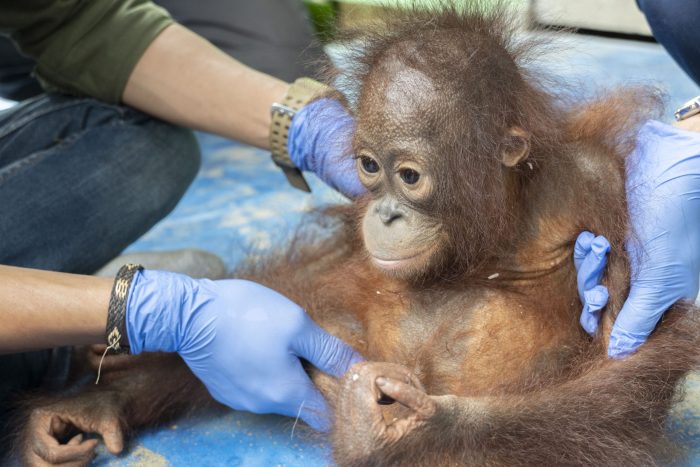
Pemeriksaan Marisa sebelum dilepasliarkan (Muffidz Masum | YIARI)
Yiari’s medical team coordinator, Fina Fadiah, confirmed that Marisa’s wounds had healed and she could be immediately returned to her habitat. “Currently, Marisa’s wounds have healed and after a series of examinations, we believe it is time for Marisa to be returned to her habitat. When he was rescued, the wound on his leg was quite severe. There are open fractures that are already infected and festering. The wound on his right leg was also deep enough to penetrate into the muscles and bones. Fortunately, thanks to the hard work of all the teams, now the wound has recovered and Marisa is ready to be sent back to TANAGUPA,” he explained. He also explains this recovery not only focused on the physical, but also with his psychic. “We take care of Marisa by keeping in mind the principles of animal welfare. We are working to reduce her stress by minimizing direct contact with Marisa,” added Fina.
To prevent a similar conflict from happening again, these orangutans were released into areas far from settlements and community gardens. TANAGUPA was chosen as the place of release because based on the location of the rescue point, Marisa is estimated to come from the area around the TANAGUPA border. In addition, Daung Sandar Resort is also considered quite good, because based on the results of a survey conducted by the TANAGUPA and YIARI halls, the amount and type of feed is still quite high. The Status of the area as a National Park also further guarantees Marisa’s safety in the future. This location is surrounded by a river which can be a natural barrier to prevent orangutans from returning to the community garden.
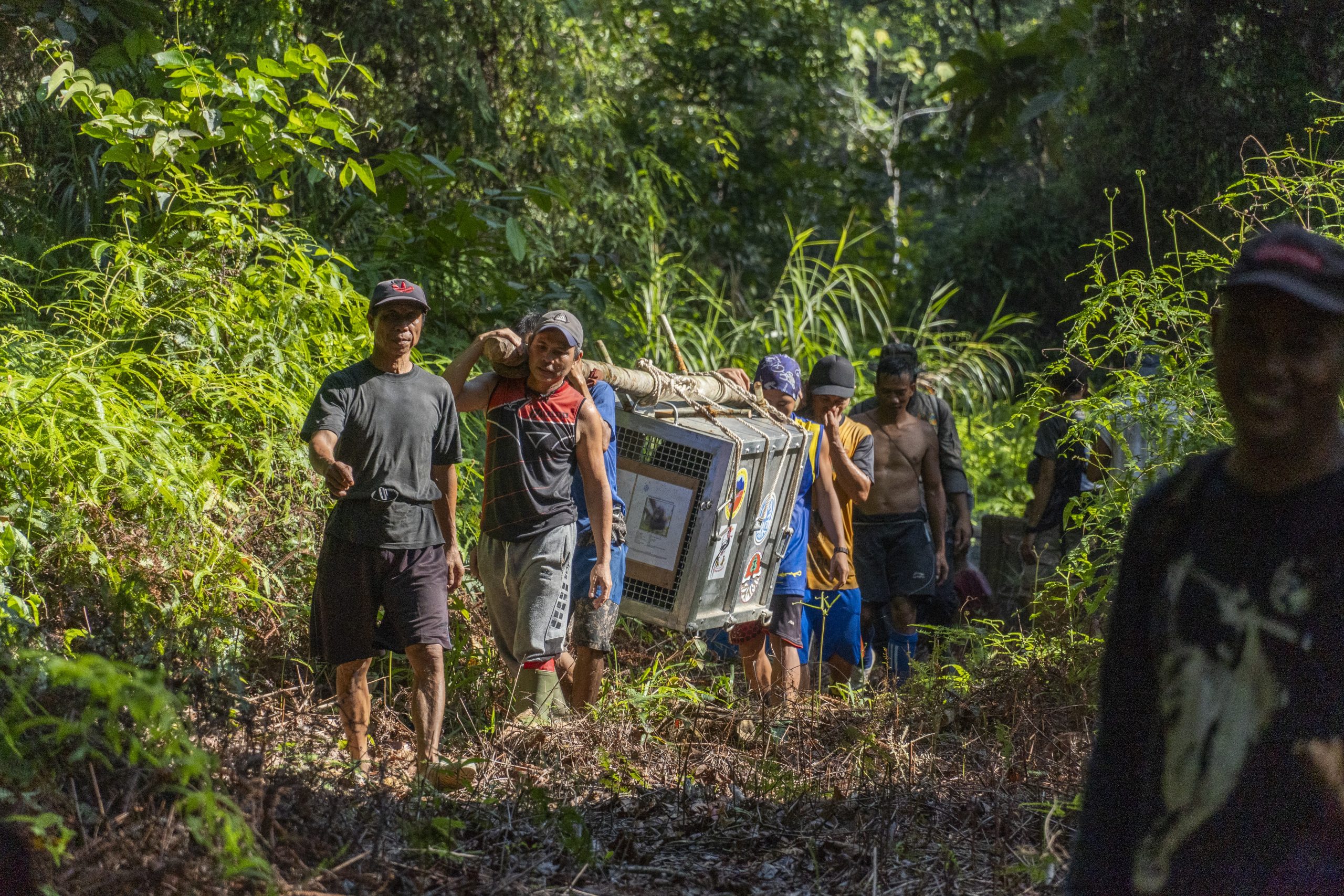
After traveling for 6 hours from the yiari Orangutan Rehabilitation Center, the team managed to reach the release point. Marisa was released in the TANAGUPA area. This success certainly cannot be separated from the support of the community who participated in helping to bring orangutans into the National Park area.
Perjalanan menuju lokasi pelepasliaran (Muffidz Masum | YIARI)
Chairman of YIARI, Silverius Oscar Unggul, expressed his appreciation for the collaboration between the government, Non-profit organizations (NGO), and the community in efforts to preserve orangutans and their habitat. Silverius stressed the importance of a shared role in maintaining this sustainability. “We invite all stakeholders, especially the community, to be at the forefront of wildlife conservation efforts, especially orangutans and their habitats. The discovery of orangutans in the community garden area is a reminder of the importance of strengthening cooperation, especially with communities living around orangutan habitat areas. If people who live on the border of orangutan habitat can live harmoniously side by side, orangutans can be preserved and enjoyed by future generations.”
“This is in line with YIARI’s vision to create a world where humans and animals coexist in a healthy ecosystem. This also supports the direction of the Minister of Forestry, Raja Juli Antoni, in his speech at the handover ceremony for the position of Minister of Forestry which emphasizes that we all have the spirit of how to maintain the balance of life with nature,” he concluded.
Himawan Sasongko, head of the TANAGUPA Center, said: ‘the release of this young orangutan is a new form of hope after losing its mother due to conflict with humans. We are committed to ensuring it can live independently in its natural habitat. And it is our shared responsibility to replace the role of the mother orangutan by ensuring the recovery of physical and psychological health and behavior in the Rehabilitation Center and then provide a place to live that can ensure its survival, but keep in mind that no matter how great and advanced our knowledge, we will never, ever again be able to replace mother in nature. Through this release, we hope the orangutans can rediscover a new life in their natural habitat and become a symbol of the importance of harmony between humans and Wildlife.’
About YIARI
Yayasan Initiasi Alam Rehabilitasi Indonesia (YIARI) is a non-profit organization engaged in the conservation of primates in Indonesia based on rescue, recovery, release, and post-release monitoring efforts. YIARI is also committed to provide protection of primates and their habitats with a holistic approach through multi-stakeholder cooperation to realize a harmonious ecosystem between habitats, animals, and humans.
For more information, please contact:
Yiari: +62 821-5346-2720 (Heribertus Suciadi, media and Communication Manager of YIARI)
Loris cystotomy surgery: removal of stones from Shuri’s bladder
Lying weak in the action room, a male Javanese slow loris named Shuri seemed to calm down under the influence of anesthesia.
But despite the calm, his body was struggling with a serious condition—two fairly large stones lodged in his bladder. Such stones, if not treated immediately, can provoke dangerous complications that threaten his safety.
Shuri is not a young sloth. He is among the elderly slow loris individuals who are under care at the Indonesian rehabilitation nature initiation Foundation (YIARI). In a routine X-Ray examination, there were two stones in Shuri’s bladder. This condition requires immediate medical action through a cystotomy surgical procedure, which is surgery to remove stones from the bladder.
Then, where did the stone inside Shuri’s bladder actually come from? Come on, check out the further explanation below!
What Is Cystotomy Surgery?
To deal with Shuri’s condition, YIARI’s medical team performed a cystotomy, a surgical procedure performed to remove stones from the bladder.
This surgery is also common in other animals—even humans—when bladder stones are already large and cannot be removed naturally.
According to drh. Imam Arifin, a veterinarian who handles Shuri directly, cystotomy becomes the only best option in this case.
“Cystotomy surgery means bladder surgery on Loris. The goal is to take the stone, because in Shuri’s bladder two large stones have formed,‘ he explained.
drh. Imam Arifin performed a cystotomy operation on Shuri (Rendi Afandi | YIARI)
If they are not removed immediately, the stones can disrupt the voiding process, cause pain, and in the long term provoke infections up to organ damage.
“If left unchecked, more serious complications can arise. That is why fast and precise action is needed,’ added Imam.
Cystotomy surgery is not done carelessly. This procedure requires careful preparation because Loris include animals that are very sensitive to stress. Even a slight overpressure can drastically affect their physiological condition.
Therefore, before the surgery is performed, the medical team must ensure that Shuri is stable and strong enough to undergo anesthesia as well as surgery.
Operation process: two stones were successfully removed from Shuri’s bladder
After being confirmed to be in stable condition, Shuri is scheduled to undergo surgery on January 16, 2025. Despite his no longer young age, this male slow loris showed a fairly good body response ahead of the procedure.
That morning, the action room at the yiari facility was specially prepared. All sterile instruments, anesthetic drugs, and veterinary medical support have been prepared. Shuri was carefully positioned, and the process of total anesthesia was carried out so that she did not feel pain during the operation.
“During the operation, Shuri seemed to be sleeping peacefully. This is very important to avoid excess stress, because Loris are very sensitive to pain and pressure,” explains drh. Priest.
Surgery is performed directly by drh. Imam Arifin, assisted by several other medical personnel. The operation went smoothly, two stones were successfully removed from Shuri’s bladder. The stones have a flattened shape and are white, exactly as the previous X-Ray showed.
The size of the stone is quite large when compared to the size of Shuri’s body. This further confirms the existence of the Stone has the potential to seriously disrupt the urinary system if not immediately addressed.
“The operation went well. Two stones that settled in the bladder were successfully removed completely without complications. We are relieved to see the results, ‘ said Imam.
After the operation is completed, Shuri is transferred to the recovery room. In the first few hours, the medical team continuously monitors his vital signs: heart rate, body temperature and respiratory response. All are within normal limits.
Although still in a weak condition, Shuri’s response shows her body is starting to adjust to the postoperative recovery process.
What are the causes of the formation of stones in the bladder of a slow loris?
The appearance of stones in the bladder is not something that happens suddenly. There are a number of factors that can generally trigger the formation of such stones in animals, including Loris. According to drh. Imam Arifin, these factors include:
Inappropriate type of food or diet
Urinary tract infection
Genetic factors
urine pH that is too alkaline or too acidic
Advanced age
Shuri’s condition while in the action room (Rendi Afandi | YIARI)
Shuri, as an old male Loris, is likely to experience a natural decline in organ function. This can affect the excretory system, including the quality and pH balance of urine.
However, the priest stated that it could not be ascertained specifically the dominant factor causing the formation of stones on Shuri.
“The factors are many. It can be due to food, it can also be due to a changed urine pH. But in Shuri’s case, we haven’t been able to determine the exact cause. Further urine analysis we will do”’ said Imam.
To ascertain the root of the problem, YIARI’s medical team will perform a urinalysis to check the composition of Shuri’s urine, including mineral levels, pH, and potential for infection.
The results of this examination will be very important to determine future preventive measures, not only for Shuri, but also other lorises that are in the rehabilitation program.
Regarding possible food factors, Imam explained that the loris feed in YIARI has been adapted as close as possible to their natural food in the wild. The feeding of fruits, small insects and foliage is ensured in the right portions and frequency.
“Our feed has been arranged to follow their diet in nature. But to be sure, we will still re-evaluate and adjust if necessary,” he added.
Challenges when performing cystotomy surgery
Handling wildlife in critical condition is not an easy task, especially when medical procedures involve surgery such as cystotomy surgery.
Although Shuri is not the first case encountered, any medical action still requires high physical and mental readiness from the veterinary team.
Portrait of two stones successfully removed from Shuri’s bladder (Rendi Afandi | YIARI)
drh. Imam Arifin revealed that the operation on Shuri was the third case of cystotomy on Loris that he had handled with YIARI’s team in recent years.
“This is not the first experience, but each case must have its own challenges. Moreover, Loris are primates that are very sensitive to stress. That makes the handling must be extra careful, ‘ explained Imam.
He recalled the first time he performed a cystotomy on a slow loris several years ago. At that time, Imam admitted that he had doubts because of the lack of references and experience in the practice of similar operations on animals with unique characteristics such as Loris. But after the first successful operation, his confidence increased, and the medical approach was refined over time.
“The first time, Honestly I was tense. But we learned a lot from that experience. Now, we’re better prepared, more structured. But still, one must be vigilant-because the risk remains great, ‘ he added.
One of the biggest challenges in this surgery is maintaining the physiological stability of the loris during the procedure. Loris can experience a sudden drop if stressed, even just because of noise or changes in room temperature. Therefore, YIARI always ensures that the operating room is quiet, sterile, and the team works with neat coordination and minimal distraction.
The priest also stressed that although the stones removed from the bladder look small, the impact can be enormous on health. If not treated immediately, the stone can provoke serious infections, inflammation and organ damage that is difficult to recover from.
Yiari’s commitment to Wildlife Health
Shuri’s story is a true reflection of YIARI’s relentless commitment to the welfare of wildlife, especially those in rehabilitation. Each individual treated animal, including Loris such as Shuri, receives attention and thorough treatment, from early detection of the disease to advanced medical procedures.
Shuri’s experience is a reminder that animal health needs to be monitored regularly, especially for the elderly. Not only that, this story also opens a wider discussion space about the importance of advanced research, community education, and cross-party collaboration in maintaining the preservation and welfare of Indonesia’s wildlife.
Featured image: Shuri, kukang jawa jantan lansia yang harus menjalani operasi sistotomi (Rendi Afandi | YIARI)
Editor: Hasna Latifatunnisa
Covita Orangutan’s struggle from malnutrition to Wild Escape in the Forest
Do you remember Covita? That’s right, the baby female orangutan who was rescued from a wildlife maintenance case was protected during the pandemic yesterday. Covita, who was then two years old, was rescued by a joint team of the West Kalimantan BKSDA and YIARI at the end of August 2020. He was kept illegally by a resident in Ensayang Hamlet, Karang Betong Village, Nanga Mahap District, Sekadau Regency. His condition at that time was malnourished and suffering from skin diseases. After being examined at our rescue and Conservation Centre, X-rays revealed a fracture in the right femur of a rifle bullet on Covita’s left thigh.
Fortunately, now Covita is free and independent in its natural habitat in Bukit Baka Bukit Raya National Park. How so? What’s the story? He’s still a baby, can he survive on his own? EITs calm down, Covita is not alone in the forest kok gangs. He was released with his foster mother named Faini.
Kondisi Covita ketika direscue (Muffidz Masum | YIARI)
More confused how the story is how Covita can get to have a foster parent of everything? So, after being rescued and receiving intensive care from our medical team at the YIARI Orangutan Rescue and Rehabilitation Center in Ketapang, Covita underwent a period of rehabilitation to restore her survival skills as an orangutan. As long as you know # KonservasYIARI, baby orangutans in nature will stay with their mothers for 6-8 years before they can live independently. It is during their stay with their mother that the orangutans learn to forage, climb, build nests and so on. Covita who had left his mother at such a young age became clueless how to survive as an orangutan in the forest, so the rehabilitation process is needed here.
Fortunately, in the rehabilitation process, Covita met a female orangutan named Faini, who was rescued by a joint team of West Kalimantan BKSDA and YIARI from Randau Jekak Village, Sandai District, Ketapang Regency in December 2015. This Orangutan also suffered an unfortunate fate, losing her mother and becoming a victim of illegal maintenance of protected animals. Faini, who is currently around 10 years old, is very concerned with Covita. In fact they then develop a natural bond as mother and child. Faini is very protective of Covita and vice versa, Covita looks comfortable and becomes more confident when she is with Faini. During the rehabilitation period, the interaction between the two leads to positive things. Thanks to Faini, Covita dared to explore the rehabilitation Forest because Faini was also actively exploring. Covita is not very good at NEST building but with Faini, she is making great progress for an orangutan her age.
When Faini makes a nest for the two of them, Covita always tries to help her foster parents make a nest by collecting twigs and leaves. One of the positive things about Covita is that she is still semi-wild and very rarely makes contact or approaches animal keepers. In fact, he tends to stay away from humans and often makes it difficult for medical teams or animal keepers who want to do an examination. They are also more active in trees. Covita and Paini are very good foraging orangutans. The foraging ability of both orangutans is astounding because their dictionary of forest food species is much more extensive than that of other orangutans. This is why our team did not hesitate to include her name in the list of orangutans that will be released soon.
Perjuangan pelepasliaran Covita dan orangutan lainnya di dalam kawasan TNBBBR pada 26 Juni 2023 (Muffidz Masum | YIARI)
In addition to the two of them, there are four other orangutans, namely Budi, Tulip, Binaca, and Jamilah who were also released inside the NNBBBR area on June 26, 2023.They all also suffered the unfortunate fate of being victims of illegal rearing of protected wildlife. Budi, who was the only male orangutan in this release, had been kept in a chicken coop for months and fed only sweetened condensed milk until he was severely malnourished until his body swelled up. Budi was rescued from Kubing, Sawah Sempurna Hamlet, Sungai Laur District, Ketapang Regency in December 2014 when he was 1 year old. After a 9-year rehabilitation period, Budi finally gained true freedom in his natural habitat.
Another Orangutan, Tulip, was rescued in April 2012 from illegal rearing by residents of Delta Pawan Sub-District, Ketapang Regency. Today tulips are estimated to be 13 years old. Bianca, a 7-year-old female orangutan, was rescued by the West Kalimantan conservation and natural resources agency (Balai KSDA) in Randau Jungkal Village, Sandai District, Ketapang Regency on October 5, 2016. Jamilah, a 9-year-old female orangutan, was rescued in Sandai, Ketapang Regency in February 2016.
Let us wish them all health always in their homes in Bukit Baka Bukit Raya National Park.
Heribertus Suciadi
Support Indonesia’s protected animals by sharing this story on your social media or donate to animals in our rehabilitation center by clicking the link here.