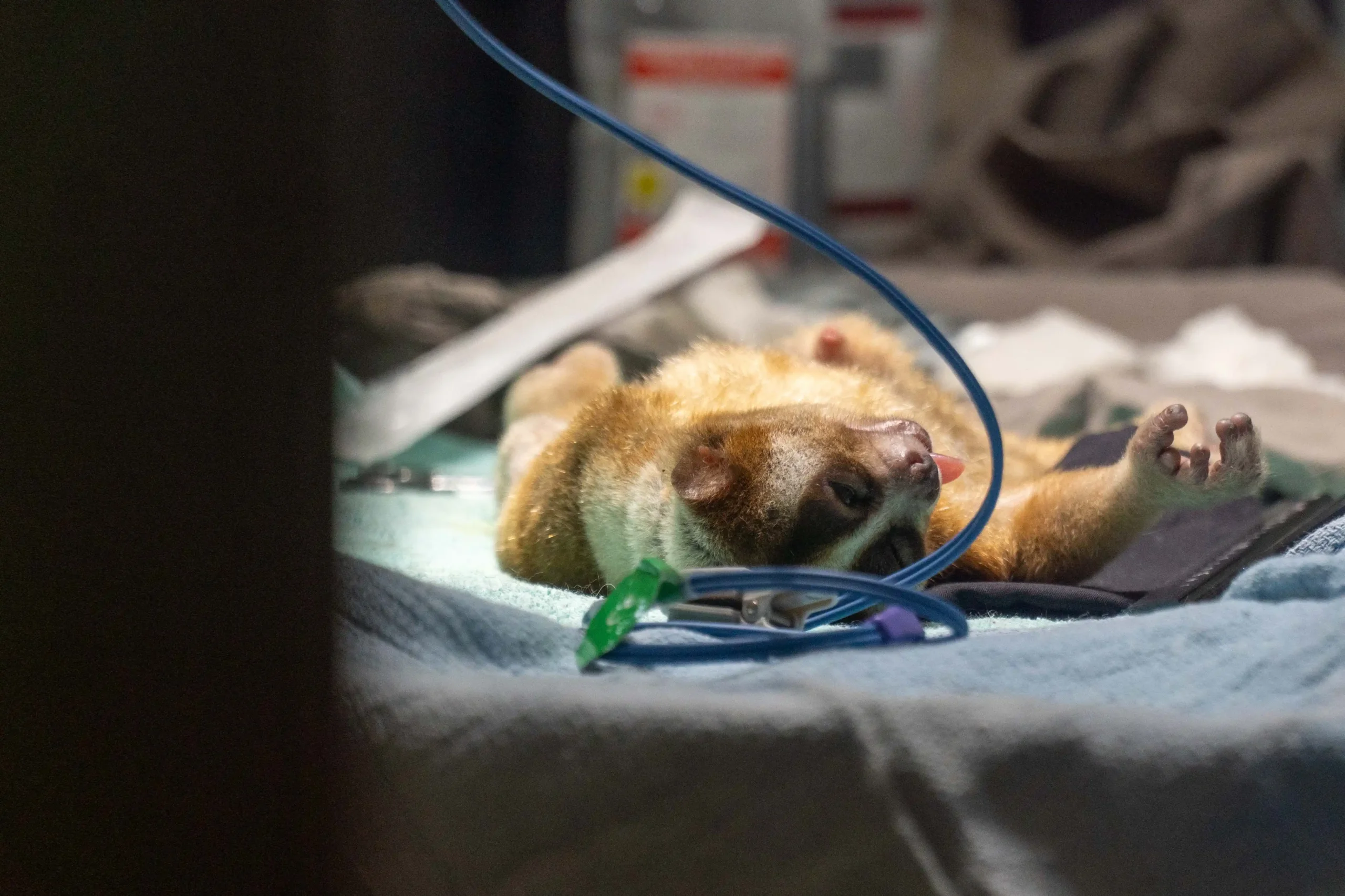
Lying weak in the action room, a male Javanese slow loris named Shuri seemed to calm down under the influence of anesthesia.
But despite the calm, his body was struggling with a serious condition—two fairly large stones lodged in his bladder. Such stones, if not treated immediately, can provoke dangerous complications that threaten his safety.
Shuri is not a young sloth. He is among the elderly slow loris individuals who are under care at the Indonesian rehabilitation nature initiation Foundation (YIARI). In a routine X-Ray examination, there were two stones in Shuri’s bladder. This condition requires immediate medical action through a cystotomy surgical procedure, which is surgery to remove stones from the bladder.
Then, where did the stone inside Shuri’s bladder actually come from? Come on, check out the further explanation below!
What Is Cystotomy Surgery?
To deal with Shuri’s condition, YIARI’s medical team performed a cystotomy, a surgical procedure performed to remove stones from the bladder.
This surgery is also common in other animals—even humans—when bladder stones are already large and cannot be removed naturally.
According to drh. Imam Arifin, a veterinarian who handles Shuri directly, cystotomy becomes the only best option in this case.
“Cystotomy surgery means bladder surgery on Loris. The goal is to take the stone, because in Shuri’s bladder two large stones have formed,‘ he explained.

If they are not removed immediately, the stones can disrupt the voiding process, cause pain, and in the long term provoke infections up to organ damage.
“If left unchecked, more serious complications can arise. That is why fast and precise action is needed,’ added Imam.
Cystotomy surgery is not done carelessly. This procedure requires careful preparation because Loris include animals that are very sensitive to stress. Even a slight overpressure can drastically affect their physiological condition.
Therefore, before the surgery is performed, the medical team must ensure that Shuri is stable and strong enough to undergo anesthesia as well as surgery.
Operation process: two stones were successfully removed from Shuri’s bladder
After being confirmed to be in stable condition, Shuri is scheduled to undergo surgery on January 16, 2025. Despite his no longer young age, this male slow loris showed a fairly good body response ahead of the procedure.
That morning, the action room at the yiari facility was specially prepared. All sterile instruments, anesthetic drugs, and veterinary medical support have been prepared. Shuri was carefully positioned, and the process of total anesthesia was carried out so that she did not feel pain during the operation.
“During the operation, Shuri seemed to be sleeping peacefully. This is very important to avoid excess stress, because Loris are very sensitive to pain and pressure,” explains drh. Priest.
Surgery is performed directly by drh. Imam Arifin, assisted by several other medical personnel. The operation went smoothly, two stones were successfully removed from Shuri’s bladder. The stones have a flattened shape and are white, exactly as the previous X-Ray showed.
The size of the stone is quite large when compared to the size of Shuri’s body. This further confirms the existence of the Stone has the potential to seriously disrupt the urinary system if not immediately addressed.
“The operation went well. Two stones that settled in the bladder were successfully removed completely without complications. We are relieved to see the results, ‘ said Imam.
After the operation is completed, Shuri is transferred to the recovery room. In the first few hours, the medical team continuously monitors his vital signs: heart rate, body temperature and respiratory response. All are within normal limits.
Although still in a weak condition, Shuri’s response shows her body is starting to adjust to the postoperative recovery process.
What are the causes of the formation of stones in the bladder of a slow loris?
The appearance of stones in the bladder is not something that happens suddenly. There are a number of factors that can generally trigger the formation of such stones in animals, including Loris. According to drh. Imam Arifin, these factors include:
- Inappropriate type of food or diet
- Urinary tract infection
- Genetic factors
- urine pH that is too alkaline or too acidic
- Advanced age

Shuri, as an old male Loris, is likely to experience a natural decline in organ function. This can affect the excretory system, including the quality and pH balance of urine.
However, the priest stated that it could not be ascertained specifically the dominant factor causing the formation of stones on Shuri.
“The factors are many. It can be due to food, it can also be due to a changed urine pH. But in Shuri’s case, we haven’t been able to determine the exact cause. Further urine analysis we will do”’ said Imam.
To ascertain the root of the problem, YIARI’s medical team will perform a urinalysis to check the composition of Shuri’s urine, including mineral levels, pH, and potential for infection.
The results of this examination will be very important to determine future preventive measures, not only for Shuri, but also other lorises that are in the rehabilitation program.
Regarding possible food factors, Imam explained that the loris feed in YIARI has been adapted as close as possible to their natural food in the wild. The feeding of fruits, small insects and foliage is ensured in the right portions and frequency.
“Our feed has been arranged to follow their diet in nature. But to be sure, we will still re-evaluate and adjust if necessary,” he added.
Challenges when performing cystotomy surgery
Handling wildlife in critical condition is not an easy task, especially when medical procedures involve surgery such as cystotomy surgery.
Although Shuri is not the first case encountered, any medical action still requires high physical and mental readiness from the veterinary team.

drh. Imam Arifin revealed that the operation on Shuri was the third case of cystotomy on Loris that he had handled with YIARI’s team in recent years.
“This is not the first experience, but each case must have its own challenges. Moreover, Loris are primates that are very sensitive to stress. That makes the handling must be extra careful, ‘ explained Imam.
He recalled the first time he performed a cystotomy on a slow loris several years ago. At that time, Imam admitted that he had doubts because of the lack of references and experience in the practice of similar operations on animals with unique characteristics such as Loris. But after the first successful operation, his confidence increased, and the medical approach was refined over time.
“The first time, Honestly I was tense. But we learned a lot from that experience. Now, we’re better prepared, more structured. But still, one must be vigilant-because the risk remains great, ‘ he added.
One of the biggest challenges in this surgery is maintaining the physiological stability of the loris during the procedure. Loris can experience a sudden drop if stressed, even just because of noise or changes in room temperature. Therefore, YIARI always ensures that the operating room is quiet, sterile, and the team works with neat coordination and minimal distraction.
The priest also stressed that although the stones removed from the bladder look small, the impact can be enormous on health. If not treated immediately, the stone can provoke serious infections, inflammation and organ damage that is difficult to recover from.
Yiari’s commitment to Wildlife Health
Shuri’s story is a true reflection of YIARI’s relentless commitment to the welfare of wildlife, especially those in rehabilitation. Each individual treated animal, including Loris such as Shuri, receives attention and thorough treatment, from early detection of the disease to advanced medical procedures.
Shuri’s experience is a reminder that animal health needs to be monitored regularly, especially for the elderly. Not only that, this story also opens a wider discussion space about the importance of advanced research, community education, and cross-party collaboration in maintaining the preservation and welfare of Indonesia’s wildlife.
Featured image: Shuri, kukang jawa jantan lansia yang harus menjalani operasi sistotomi (Rendi Afandi | YIARI)
Editor: Hasna Latifatunnisa