Food security is one of the main pillars in realizing the welfare of the community, especially for local communities that rely heavily on natural resources in the vicinity.
In the face of global challenges such as climate change, environmental degradation, and dependence on food supplies from outside the region, the development of self-managed Food Systems is an effective and sustainable solution.
As a form of commitment to strengthening local food security, Yayasan Initiasi Alam Rehabilitasi Indonesia (YIARI) actively encourages environmentally friendly tilapia farming practices. Through the tilapia harvesting program, YIARI supports the sustainable increase of fish production, as well as providing education to the community on efficient cultivation techniques, saving resources, and in line with conservation principles.
This article will discuss in depth about the tilapia harvesting program implemented by YIARI. Check it out!
When Is This Program Implemented?

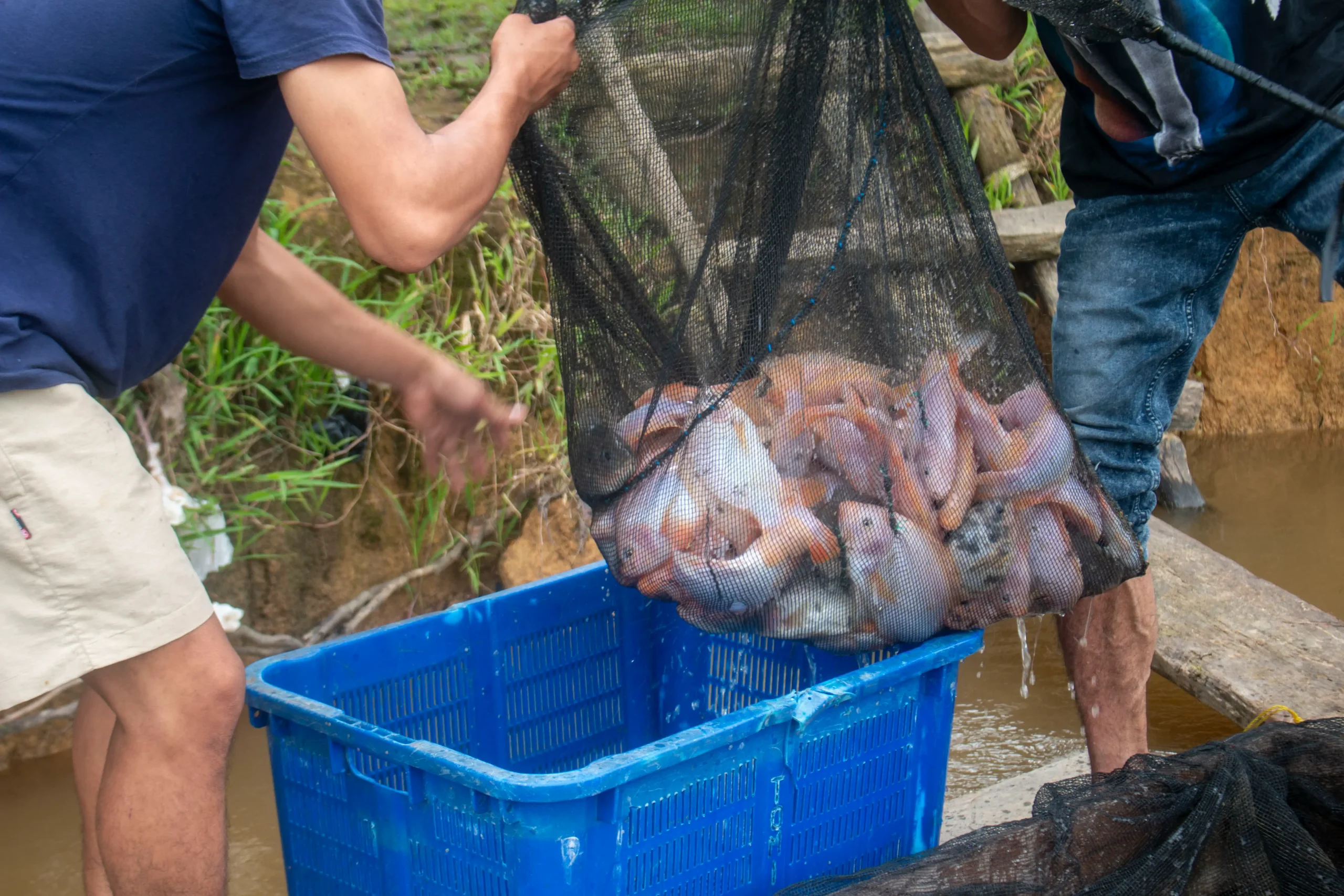
On Friday, February 28, 2025, YIARI and the Alam Lestari Joint Venture Group (KUB) carried out tilapia harvesting in Ulak Medang Village, Ketapang regency, West Kalimantan. This activity is part of a sustainable aquaculture program designed to strengthen local food security through a community-based approach.
Ulak Medang village was chosen as the location of the program because it has the potential to support water resources, as well as high community spirit to develop independent cultivation. Active citizen involvement is key in every stage of the activity—from pond management, feeding, to harvesting.
Through this activity, YIARI not only channeled technical knowledge and assistance, but also instilled conservation values in cultivation practices to stay in line with environmental conservation efforts.
Yields and environmentally friendly cultivation practices
Tilapia harvest conducted in the village of Ulak Medang yielded encouraging results. In one harvest, the community managed to harvest 409 kilograms of tilapia. This achievement not only shows the success in terms of quantity, but also the quality of cultivation management.
During the cultivation process, fish mortality rate (mortality) was recorded at 20%, while the value of food conversion ratio (FCR) reached 1.25. This FCR number indicates good efficiency in the use of feed—the lower the FCR value, the more efficient the fish are in converting feed into body mass.
This success certainly cannot be separated from the implementation of environmentally friendly cultivation practices. Since its inception, the program has been designed with a conservative approach to maintaining the health of Fish and the quality of aquatic ecosystems. Some of the main principles applied include:
- Periodic monitoring of water quality to maintain optimal conditions for fish growth.
- Setting the stocking density so that the fish are not stressed and the living space remains sufficient.
- Selection of high-quality and efficient feed, thus supporting growth without polluting the environment.
- Responsible management of aquaculture waste so as not to damage the ecosystem around the pond.
Tilapia Harvesting Challenges
Behind the success of tilapia farming, there are a number of significant challenges faced by farmers in the field. Some of the following major obstacles are of serious concern in the management of sustainable cultivation.
Here are the challenges and solutions that have been pursued by YIARI together with the Joint Venture Group (KUB) Alam Lestari:

1. Fluctuations in the selling price of fish
The selling price of tilapia in the market tends to be unstable because it is influenced by various factors, such as fluctuations in consumer demand, harvest season, and general economic conditions.
Based on data from the Central Statistics Agency (BPS) in 2022, the price of freshwater fish—including tilapia—can change between 10% to 20% in a matter of months, depending on stock dynamics and market demand.
This price instability has a direct impact on the income of farmers, who often have to sell crops at prices below production costs. To overcome this challenge, we together with Kub Alam Lestari took the initiative to build a wider and more stable marketing network.
One of the strategic steps taken is to establish direct partnerships with regular buyers, such as traditional markets and cooperatives. Through this approach, farmers can reduce dependence on open markets and ensure a more secure revenue stream.
2. High feed prices
Feed is the largest cost component in Tilapia farming, which according to a report by the Ministry of Marine Affairs and Fisheries (MMAF), can reach 60-70% of total operating costs.
In recent years, commercial feed prices have continued to rise, driven by the high cost of raw materials such as fishmeal and soybeans, most of which are still imported.
This increase is very burdensome cultivation actors, especially small and medium scale. To reduce dependence on commercial feed, we started developing locally based solutions through alternative feed production.
Ingredients such as lamtoro leaves, rice bran, and maggot (BSF fly larvae) which are rich in protein are the main choices. This approach not only helps reduce operational costs, but also supports more environmentally friendly cultivation practices by utilizing easily accessible local resources.
3. Communication Between Group Members
Cultivation in a group scheme requires solid coordination and communication between members. Each individual must apply the same cultivation standards, from water quality management, feeding, to harvest scheduling.
In practice, however, differences in experience, technical understanding and way of working are often a source of imbalance.
To strengthen synergies within the group, we actively encourage information disclosure and conduct regular joint training. In addition, regular discussion forums are also facilitated to provide space for members to share experiences, discuss technical challenges, and find solutions together.
Effective communication is proven to increase production efficiency and help reduce potential conflicts in collective business management.
Benefits Of Tilapia Fish Harvest

For the people of Ulak Medang village, harvesting tilapia is not just an economic activity, but a reflection of changes in a more sustainable way of life. This Program has a real impact, both in terms of family income and environmental awareness.
One of the members of KUB Alam Lestari, Kusmaheru, shared his experience:
“In harvesting tilapia this time, my cage produces 100 kg of fish which is immediately sold out. Before joining this program, I worked as a woodcutter. Yes, my intention is actually to change from woodworking, and I live a business with this KUB too, I see first the situation and how the results are. If it does produce, the next good step I will stop working on wood.”
Kusmaheru’s story is proof that tilapia farming can be a way out of dependence on activities that have the potential to damage forests. In addition to generating economic benefits, this activity also encourages social transformation that is more environmentally friendly.
Not only that, the success of the harvest also opens up new opportunities for other family members to get involved, ranging from crop processing to distribution to the local market. In the long run, this strengthens the resilience of families and extends the benefits of the program to a wider stratum of society.
Looking To The Future Of Sustainable Cultivation
Tilapia cultivation developed in Ulak Medang village shows that food security and environmental conservation can go hand in hand. Through a community-based approach, the program not only produces successful harvests, but also fosters a new awareness of the importance of maintaining the balance of nature.
In the future, this activity is expected to be an inspiring model for other villages that want to develop an independent food system. Tilapia farming is not only about meeting the needs of the kitchen, but also about keeping the forest sustainable, reducing pressure on nature, and strengthening people’s independence.
Because in the end, planting hope means reaping the future.

