Have you heard about local wisdom such as Ngaben ceremony in Bali or Reog Ponorogo from East Java? Each country has its own unique culture, but Indonesia holds something truly special: local wisdom that is an integral part of the nation’s identity.
Behind these various traditions, noble values are hidden that remain alive and relevant, even in the midst of the currents of modernity that continue to move forward. Imagine how Balinese people prepare the Ngaben procession with sincerity, or how the music and magical movements in the Reog Ponorogo show are able to captivate the attention of anyone who witnesses it. This is not just a ritual or entertainment per se—it is a reflection of the wisdom of ancestors passed down from generation to generation.
With more than 300 ethnic groups and 1,340 ethnic groups scattered throughout the archipelago, local wisdom is a clear proof of the richness and diversity of Indonesian culture.
In fact, according to data from the Ministry of Education and culture in 2024, more than 250 cultural traditions have been officially registered as Intangible Cultural Heritage. However, an important question arises: is all this wisdom able to survive in the midst of the rapid influence of foreign cultures and the development of modern technologies?
To answer this question, you need to re-understand what is meant by local wisdom.
What is local wisdom?
Local wisdom is a set of knowledge, values, norms, and practices that grow and develop in a community, based on life experiences and culture that are passed down from generation to generation.
This wisdom serves as a guideline in various aspects of life—whether social, economic, ecological, or spiritual.
According to Sibarani (2012), local wisdom is the original knowledge derived from the culture of the local community and passed down from generation to generation.
Meanwhile, Keraf (2002) emphasized that local wisdom includes all forms of understanding, beliefs, insights, and habits that guide human behavior in maintaining social balance and environmental sustainability.
What are the characteristics of local wisdom?
Local wisdom is not just a cultural heritage, but also part of the identity and character of a community. This wisdom contains noble values that are passed down from generation to generation and remain relevant in modern life.
Here are some characteristics of local wisdom:
- Passed down through generations: local wisdom is passed down from generation to generation through stories, daily practices and traditional rituals.
- Based on local experience: local wisdom is born from the adaptation of the community to local geographic, social, and cultural environmental conditions.
- Practical and applicable: local wisdom is not just a theory, but is directly applied in everyday life to solve various practical problems.
- Support social harmony: local wisdom encourages the creation of a sense of community, mutual cooperation, and solidarity in the community.
- Contains moral and ethical values: teaches noble values that govern the relationship between humans, humans and nature, as well as humans and the creator.
The Benefits Of Local Wisdom
Actually, what is local wisdom preserved for? Is it just because it’s been there for a long time? The answer is no.
Local wisdom is not just a tradition, but it has real benefits that are very relevant to our lives, both on an individual and social scale. Here are some of the benefits of local wisdom:
1. Maintaining the sustainability of nature and resources
Local wisdom teaches how to interact with nature in a balanced and thoughtful way. The values contained in it encourage people to take care of the ecosystem and use natural resources sustainably.
By applying local principles that are oriented towards sustainability, the environment can be preserved and utilized without damaging its balance.
2. Strengthening cultural identity and pride

Local wisdom is part of the identity of a community group. He became a marker of cultural uniqueness that distinguishes one community from another.
When local values are valued and maintained, the cultural identity will be stronger and not easily eroded by the changing currents of the Times.
3. Promoting social harmony
In local wisdom, there are norms that regulate social behavior and create order in society.
Principles such as cooperation, equality, and mutual respect are the basis for building harmonious interpersonal and interwar relationships. This creates social stability and strengthens ties within the community.
4. Encouraging economic empowerment
Cultural values passed down through generations often manifest themselves in the form of distinctive skills, knowledge, and products of economic value.
When local wisdom is developed productively, it can become a resource that supports people’s economic activities, creates jobs, and improves welfare sustainably.
5. Building character and moral values
Local wisdom is loaded with moral teachings that shape people’s personality and ethics. Through these values, positive attitudes such as respect, responsibility, empathy and honesty are formed.
Internalizing the moral values of local wisdom contributes to creating a society of integrity and noble culture.
Types of local wisdom
From various sources, we can find many types of local wisdom. But in general, we can categorize local wisdom as follows.
1. Customs
Customs are rules and habits that regulate people’s lifestyles, ranging from how to dress, social interaction, to the procedure for conducting traditional ceremonies.
For example in Bali, there is a system of temples and penjor used in celebrating religious holidays. These two elements are not only symbols of beauty, but also illustrate the harmony of the relationship between man, nature and the creator.
This kind of tradition teaches the values of peace, togetherness, as well as respect for ancestors.
2. Traditional farming system
In various regions, the community is still implementing an agricultural system based on local wisdom that is proven to be environmentally friendly and sustainable.
One example is the Subak system in Bali. This system regulates the equitable distribution of water through cooperation between farmers and is based on the philosophy of Tri Hita Karana, which emphasizes the balance between man, nature and God. This practice is a proof of local wisdom able to create harmony between agriculture and environmental conservation.
3. Folklore and legends
Folklore is a medium used by previous societies to convey moral and ethical values to the next generation.
Who has not heard the story of Malin Kundang? This legend teaches the importance of filial piety to parents and serves as a warning of the consequences of ungodly attitudes.
This kind of story remains alive in society and continues to be told orally and in writing, making it an important part in the formation of cultural character.
4. Arts and crafts
Traditional arts and crafts are a form of local wisdom that is realized through cultural expressions and hereditary skills.
For example, the craft of batik, weaving, and wood carving developed in various regions such as Yogyakarta, Pekalongan, and Jepara. In Yogyakarta and Pekalongan, batik is not only preserved as a cultural heritage, but also developed into a creative industry that is highly competitive and empowers local communities.
The distinctive batik motifs hold a deep philosophy about life, the environment, and socio-cultural values.
5. Natural Resources Management System
Local wisdom in natural resource management reflects public awareness of the importance of maintaining ecosystem balance.
A vivid example can be found in indigenous villages in Kalimantan, where communities implement sustainable forest management systems. They have customary rules governing when and how forests can be used.
6. Religious ceremonies and rituals
Every region in Indonesia has traditional ceremonies and religious rituals that are part of their cultural identity.
In Bali, for example, the Ngaben ceremony is a tradition of cremation that aims to transport the spirit of the deceased to the afterlife. This ceremony not only shows respect for ancestors, but also teaches the importance of maintaining a balance between man and the universe.
7. Language and proverbs
Regional languages and proverbs are important containers to convey the values of local wisdom.
In the Javanese language, there is a proverb ‘Adigang, adigung, adiguna’, which means that someone who only relies on strength, power, or intelligence without considering moral values will be easily stumbled by his own arrogance. This proverb is a reminder to always be humble and not boast excessively.
8. Culinary traditions
Traditional culinary is not just a matter of taste, but also full of cultural meaning and social value. In West Sumatra, for example, rendang is not only known as a delicious food, but also represents the philosophy of life of the Minangkabau people.
Rendang cooking process that requires patience and work together illustrates the value of mutual cooperation, perseverance, and respect for tradition.
9. Traditional music and dance
Traditional music and dance are forms of cultural expression that are often used in traditional celebrations and religious rituals.
In East Java, Reog Ponorogo dance is an example of how performing arts are used to convey stories of heroism and strength. Apart from being Entertainment, this show also strengthens social relations and strengthens the cultural identity of the region.
Examples Of Local Wisdom
After understanding the basic concepts of local wisdom, now is the time to get to know more closely some real examples from various regions in Indonesia.
Although it may not be widely known, the following traditions reflect the noble values, togetherness, and wisdom in the lives of local people.
1. Mappalette Bola-South Sulawesi

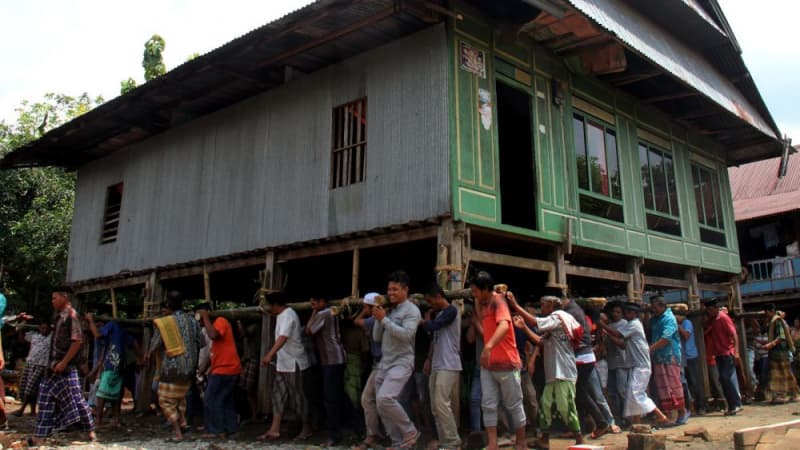
Mappalette Bola is a mutual cooperation tradition originating from the Bugis and Makassar communities in South Sulawesi.
In this tradition, residents join hands to help move a house on stilts from one location to another together.
The process of moving the house is done by lifting the structure of the house manually using bamboo as a buffer. In addition to showing physical cooperation, Mappalette Bola reflects the strong value of solidarity and collective spirit in community life.
2. Omed-Omedan-Bali

Omed-Omedan is a unique tradition carried out by young people in Banjar Kaja, Sesetan Village, Denpasar, right after Nyepi Day.
In this ceremony, two groups of young people face each other, then pull and hug each other, which in practice is sometimes accompanied by a light kiss.
This tradition is believed to be a symbol of rejecting reinforcements as well as a form of supplication for good luck and fertility in the new year. More than just a cultural attraction, Omed-Omedan teaches the importance of togetherness, compassion, and social sustainability in the community.
3. Gumiwang Traditional Institution (West Java)
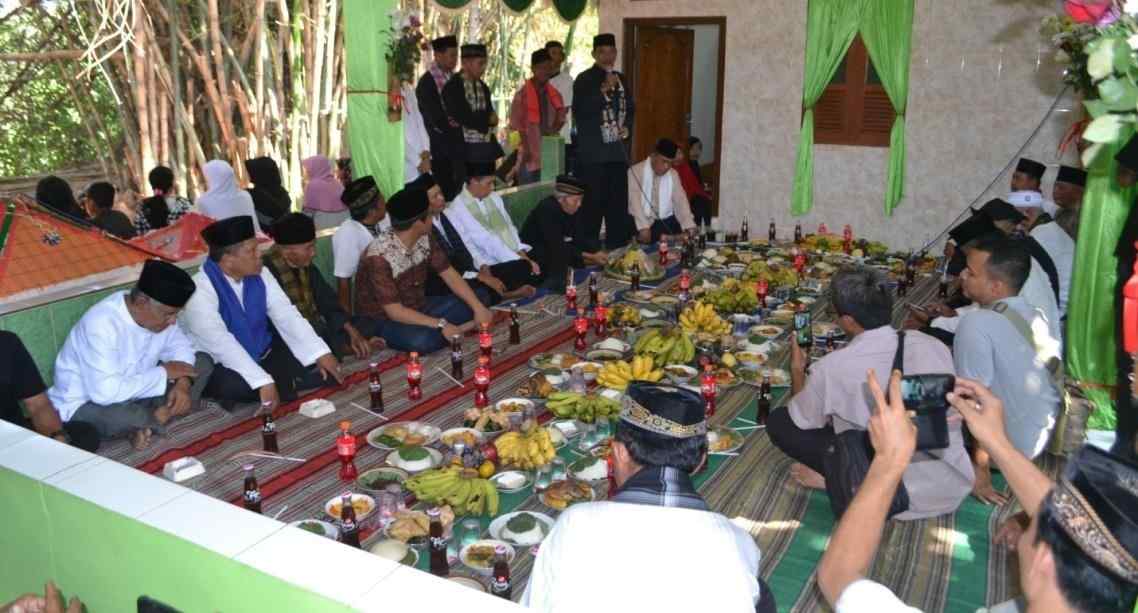
In Gumiwang Village, Kuningan Regency, West Java, the community implements a system of customary law known as Lembaga Adat Gumiwang.
This system focuses on conflict resolution through deliberation and consensus, without necessarily involving formal legal institutions.
One of the important elements in this tradition is the Ngajayakake ritual, which is a meeting of citizens to discuss and resolve social issues openly. This process emphasizes the importance of mutual respect, listening, and finding solutions together, so as to maintain harmony in community life.
4. Ngarot – Indramayu Ceremony

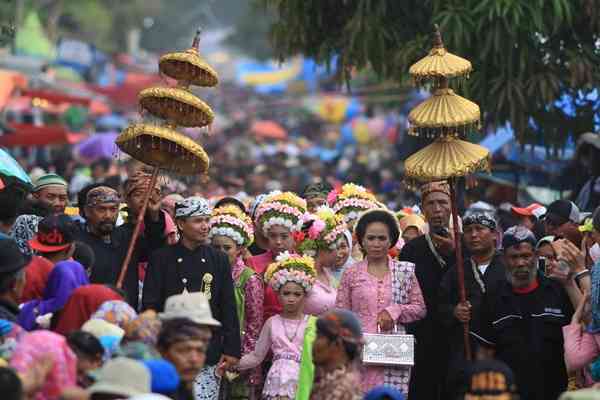
Ngarot ceremony is a typical tradition of the agrarian community in Lelea District, Indramayu Regency, West Java. This tradition is held as a form of gratitude to God for the abundant harvest, as well as a request for blessings for the next growing season.
The ngarot procession is usually carried out before the rice planting period, involving the youth and young people of the village. They wear brightly colored traditional clothing and bring produce such as rice, vegetables, and fruits to be offered at the shrine. The series of events was also enlivened by traditional music performances, regional dances, and a lively procession.
More than just a celebration, the Ngarot ceremony reflects respect for nature and reinforces the value of togetherness and cultural preservation among the younger generation.
5. Te Aro Naweak Lako – Papua
Te Aro Naweak Lako is a philosophy of life that comes from the indigenous people in Papua, which literally means ‘nature is part of us’. This value contains a deep meaning that the relationship between man and nature is unified and interdependent.
This philosophy is not only a hereditary teaching, but also reflected in the daily life of the Papuan people. In the practice of hunting, farming, and utilizing forest products, they always maintain the balance of nature with full awareness and responsibility.
For example, they only take in moderation and avoid overexploitation, as a form of respect for nature that they consider a relative.
Through Te Aro Naweak Lako, Papuans remind us that caring for nature is not only an obligation, but also a part of cultural identity that is passed down from generation to generation.
Preserving Heritage, Caring For Identity
Well, buddy # konservasYIARI, it turns out that local wisdom stores so many incredible benefits, right? Not only as a cultural heritage that enriches the identity of the nation, local wisdom can also be a Relevant Life Guide in facing various challenges of modern times.
As the next generation, it is our responsibility to maintain and preserve these noble values. Do not let the advancement of technology and today’s lifestyle make us forget or even ashamed of our own cultural roots. In fact, the more we recognize and appreciate local wisdom, the stronger the National Foundation that we build.
Many people are gathering at the event Salvation / source: Budayaanbetawi


:strip_icc():format(jpeg)/kly-media-production/medias/1551394/original/007855000_1490846764-20170329-Muda-mudi-Rayakan-Tradisi-Omed-omedan-Setelah-Hari-Raya-Nyepi-AP-5.jpg)