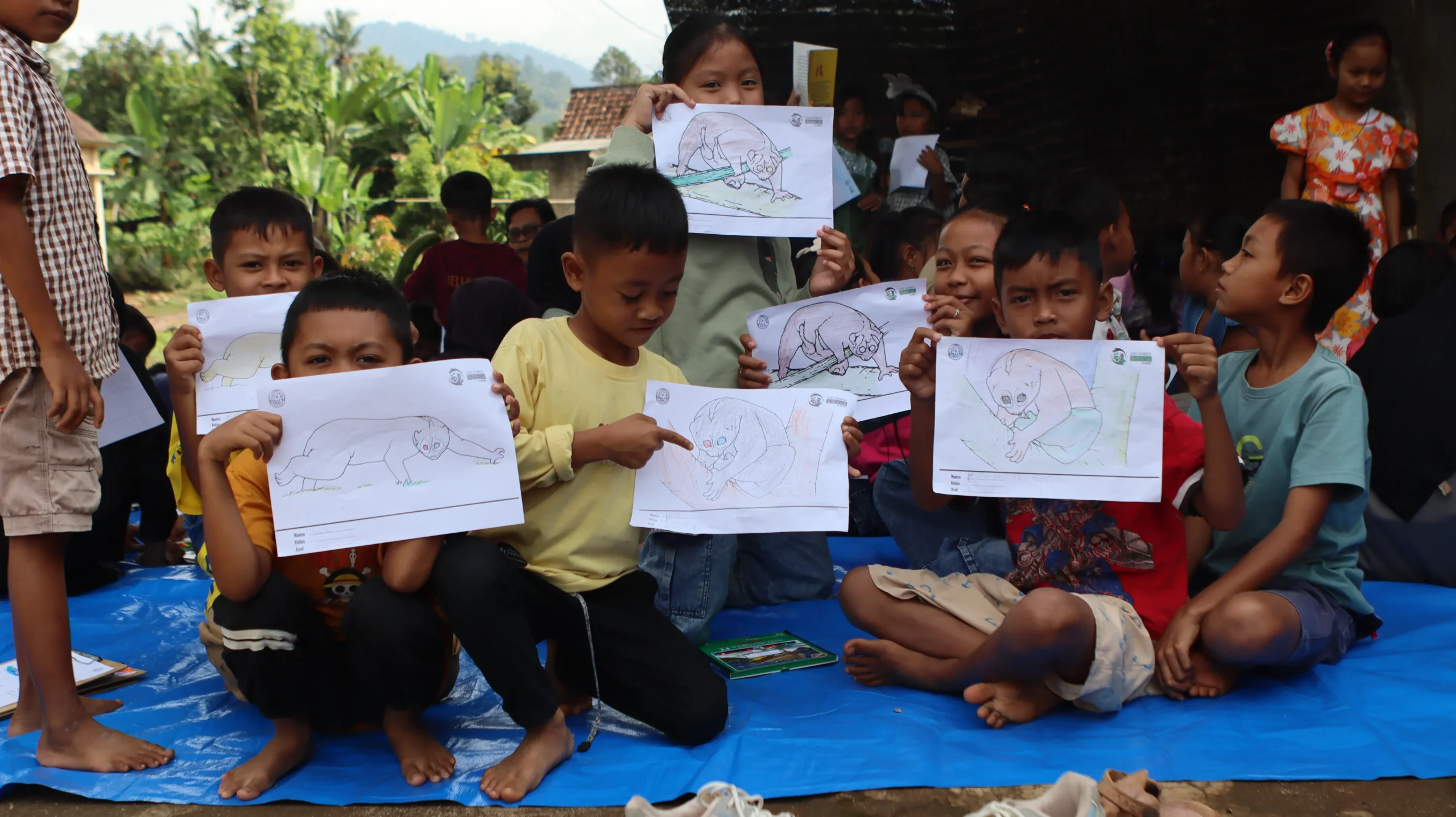
On February 9, 2025, educational activities in commemoration of Indonesian Primate day were successfully held in Dusun Beringin 4, Lampung. This event involved as many as 52 children from farming families, who came from pre-PAUD to Junior High School.
This activity is not just a symbolic celebration, but a real step in instilling environmental awareness and the importance of conservation from an early age. Through a series of activities such as the introduction of the types of Indonesian primates, coloring, storytelling, to educational games, children are invited to learn while playing, get to know primates more closely, and understand their important role in the ecosystem.
Want to know how children in Dusun Beringin 4 Learn to love nature while playing? Check it out in this article!
What is the purpose and Output of Indonesian Primate Day Celebration activities in Dusun Beringin 4?
Educational activities in the framework of Indonesia Primate day in Dusun Beringin 4 not only aims to commemorate this important day, but also become part of a long-term strategy in wildlife conservation efforts.
According to the Indonesian Journal of Primatology, Indonesia is home to more than 59 species of primates from 11 genera, spread across a variety of habitats ranging from tropical rainforests to mountains.
Unfortunately, their existence is increasingly threatened by hunting, illegal trade, as well as massive destruction of forests.
Through this activity, YIARI designed an educational approach that targets children from farming families as the first step in building collective awareness from an early age. The main objectives include:
- Provide intensive assistance to the children of farmers assisted in understanding the importance of Wildlife Conservation.
- Improve children’s knowledge about various types of primates in Indonesia and their ecological functions.
- Instill conservation values from an early age, so that habits are formed to maintain the environment in a sustainable manner.
- Conducting surveys and collecting perceptions of children and their families to support the sustainability of conservation education programs.
A series of activities for Primate Conservation Education
Here is a series of these activities:
1. Submission of material: getting to know primates and their habitat

This session became the core of conservation education activities. The children were introduced to various types of primates that live in Indonesia, such as orangutans, langurs, and tarsiers. They were also invited to understand the ecological role of primates, for example as seed dispersers of plants that help regenerate forests.
The material is delivered through visual media such as images and educational videos to make it more interesting and easy to digest. In addition, children are also introduced to various real threats faced by primates, such as deforestation, poaching, and illegal animal trade.
Through this session, participants gain knowledge as well as expected to foster empathy and concern for wildlife.
2. Coloring

Coloring becomes one of the favorite activities that are fun and educational. The children were given illustrated sketches of Indonesian primates to be colored according to their imagination.
This activity honed motor skills and creativity, as well as a means of getting to know animals more closely through visual and artistic approaches.
With the appropriate theme, coloring becomes an effective learning media to strengthen children’s understanding of the types and characteristics of Indonesian primates.
3. Storytelling

Fairy tales are one of the most effective methods of conveying messages to children. In this session, they were invited to listen to stories that raised the theme of the importance of maintaining forests and protecting wildlife.
The story is delivered with an interesting plot and animal figures that are easily recognizable and liked by children.
Through fairy tales, children are entertained while learning that human actions can have a direct impact on the survival of animals in the wild. The moral message conveyed was able to form ecological awareness and instill conservation values from an early age.
4. Educational Games

For children, learning will be more fun if done through play. In this session, the YIARI team invited the children to participate in various educational games after completing a series of other activities.
The presented game is designed to train teamwork, accuracy, as well as critical thinking skills. With this playful learning method, children become easier to understand conservation issues and more aware of the importance of taking care of primates and their environment.
5. Reading Books

In addition to listening to fairy tales, children are also invited to read books on the theme of Wildlife Conservation. These books contain inspiring stories as well as interesting information about primates and the forest ecosystems in which they live.
This reading activity aims to instill conservation values through literacy, as well as increasing children’s interest in reading. Through stories that are packaged in a light and educational way, it is hoped that children can understand the importance of maintaining biodiversity and respecting the surrounding wildlife.
6. Children’s Perception Survey

As part of the program’s evaluation and ongoing improvement efforts, the YIARI team also conducted a survey of the children and their families. This survey aims to explore their understanding, attitude, and level of awareness towards primate conservation.
The results of the survey will be the basis for designing further educational programs to be more relevant and effective. By involving direct participation from participants, this approach helps ensure conservation activities are truly impactful and accepted by the community, especially the younger generation.
Expectations and impacts of Primate Conservation Education
With primate conservation education, there are several expectations and educational impacts that can be achieved in the short and long term, including:
1. The important role of primates in ecosystems
Primates play an important role in maintaining the sustainability of forest ecosystems. They serve as seed dispersers, insect population controllers, to natural indicators of Environmental Health. Unfortunately, the threat to primate populations continues to increase due to poaching, illegal trade, as well as habitat destruction.
Primate conservation efforts cannot rely solely on scientists or environmental activists. The involvement of the wider community, including children as the next generation, is key in maintaining the sustainability of this species in the future.
2. Conservation education for the younger generation
Through educational activities in the framework of Indonesia Primate day, yiari instills conservation values to children with a fun and interactive approach. The children were introduced to the diversity of Indonesian primates and invited to understand how human behavior can directly impact their survival.
Activities such as storytelling, coloring, reading books, and playing educational games are effective media in conveying conservation messages. With this method, children are expected to experience a learning process that imprints emotionally.
3. Short-term and long-term impact
In the short term, this activity succeeded in increasing the knowledge and awareness of children about the importance of preserving primates and the environment. Children begin to understand that simple actions, such as not buying or raising wildlife, can have a huge impact on the preservation of ecosystems.
In the future, this education is expected to produce a generation that is more environmentally conscious and plays an active role in wildlife conservation efforts. Children who grow up with conservation values have the potential to become agents of change that encourage the creation of more environmentally friendly and responsible societies.
4. Building a harmonious future
Educational activities such as Lampung Primate day prove that the learning process that is packaged in a fun way is able to foster a deep sense of empathy for nature. In addition to understanding the importance of protecting primates, children are also encouraged to be directly involved in preserving the surrounding environment.
We would like to thank all participants, volunteers, and those who have supported this activity. The spirit shown by the Children of Dusun Beringin 4 is proof that education and conservation can go hand in hand to create a better future.
Programs like this are expected to continue to grow and reach more regions, so that more Indonesian children grow up with an awareness of the importance of conservation. Let’s take care of our forest friends—primates—together for a sustainable, harmonious and sustainable future for the Earth!

