Potential zoonotic transmission in macaques, dangerous but preventable!
Happy International Makaka Day, #KonservasYIARI Friends! March 16 is celebrated International Makaka day. makaka Day is celebrated for the first time on March 16, 2016, which is motivated by love and efforts to preserve makaka around the world.
Macaque is a genus of primates found in the world. Its populations can be found ranging from Morocco, Algeria, Afghanistan, China, Japan, and Southeast Asia (Napier and Napier 1985), many also yes , man! In Indonesia, the genus Makaka also has a wide distribution level, especially on the islands of Java, Sumatra, Kalimantan, Sulawesi to the islands in Nusa Tenggara. Types of macaca that can be found in Indonesia include Macaca nemestrina, M. siberu, M. pagensis, M. nigra, M. nigrescens, M. tonkeana, M. ochreata, M. hecki, M. maura, M. fascicularis (Ruskhanidar et al. 2017).

makaka is one genus that has a fairly good level of adaptation. So, don ‘t be surprised, friend, if you are visiting a location close to where you live, then there is a possibility that you will be harassed. like the photo above, which is an incident located in the Angke Kapuk Wildlife Sanctuary, Jakarta. This happens because the habitat of the makaka is directly adjacent to human activities, which causes the makaka to get used to meeting humans.
But, don’t let you interact directly with them! Because makaka has the potential to carry viruses, bacteria, and parasites that can transmit diseases to humans. The transmission of the disease is commonly called zoonosis, which means the transmission of the disease from animals to humans or vice versa.
Do you know why it can pose a threat to humans? Because, macaques belong to the Order of primates that have genetic, physiological and behavioral similarities with humans (Schillaci et al. 2005). Primates are significant zoonotic agents or sources of disease for humans, as they can transmit 25%of emerging infectious Diseases (Pedersen and Davies 2009).
Then, how is it transmitted? There are various ways of bacterial infection from macaca to humans, either directly or indirectly. Get infected directly if you get a bite or scratch from a macaque. While indirect infection is through contaminated water, also food contaminated with Entamoeba SPP cysts. In addition, the main potential for infection is from fecal-oral and direct contact between humans and Non-Human Primates1 (Lastuti 2021). for more details, you can listen to the poster below!
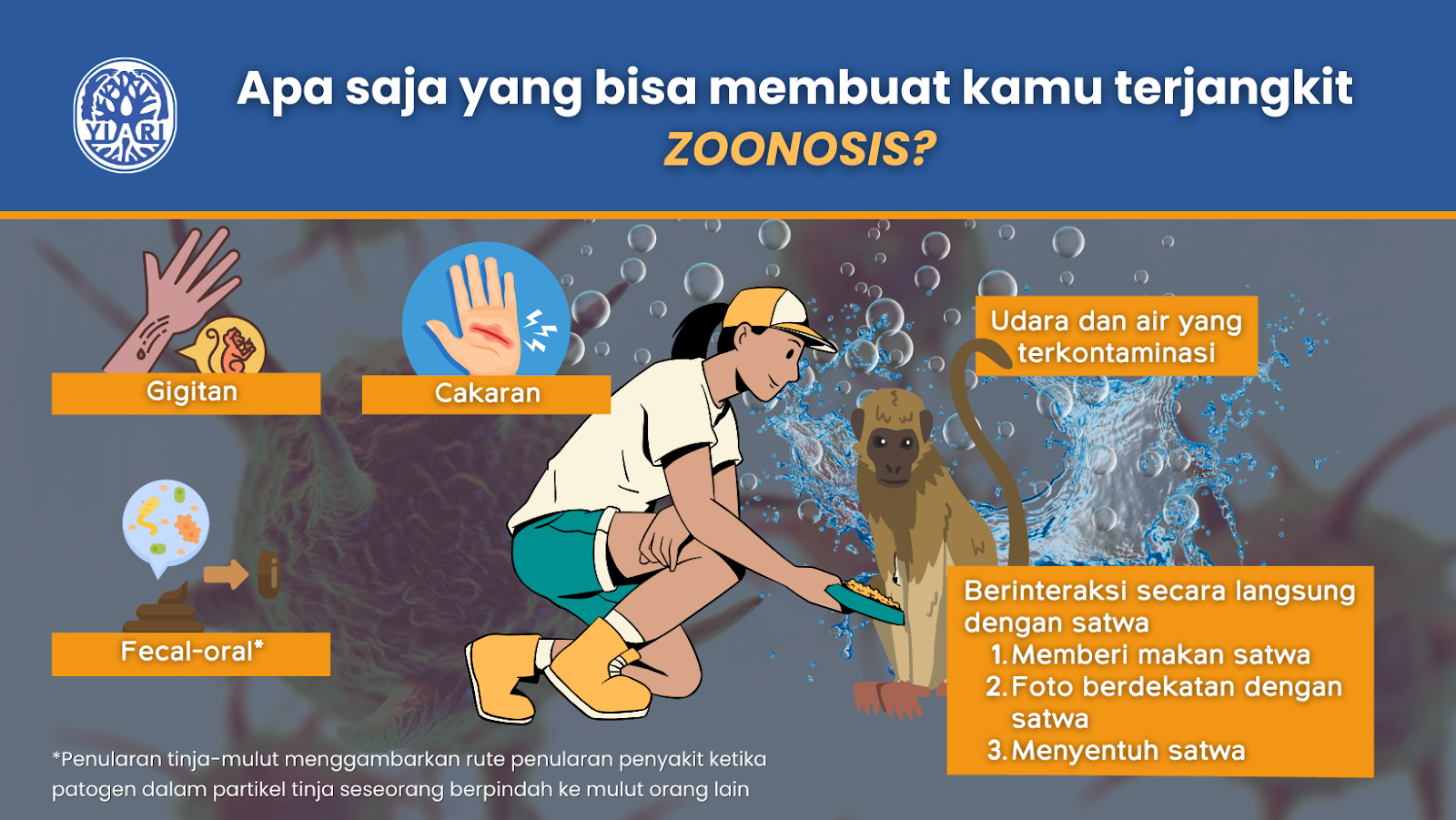
Based on research that has been carried out by Lastuti (2021), in Macaca fascicularis (long-tailed monkey) in Baluran National Park, positive results show that Entamoeba coli. bacteria is a disease agent that infects the digestive tract. In Addition To E.coli are still many disease agents carried by macaques, among others , Plasmodium knowlesi , which is parasitic on macaques in Southeast Asia (Macaca nemestrina and M. fascicularis), which can cause malaria loh Sob. (Jongwutiwes et al. 2011; Millar dan Cox-Singh 2015).
Ohiya, you should know that one of the most significant Zoonoses is tuberculosis. The main causes of this disease are the bacteria Mycobacterium tuberculosis and Mycobacterium bovis (Une and Mori 2007).
So how do we avoid Zoonoses? Buddy # KonservasYIARI can do early prevention in the following ways !
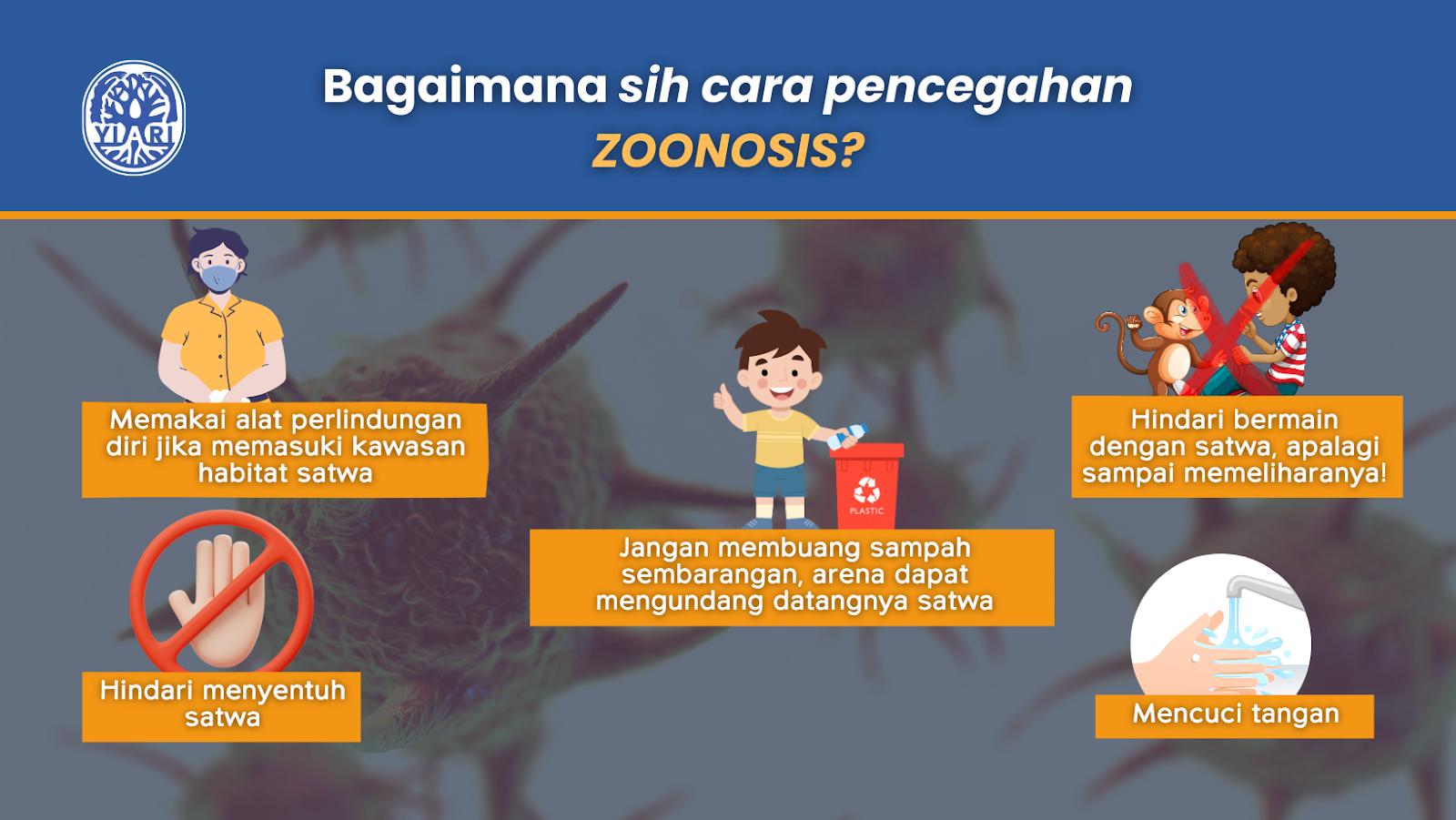
The potential transmission of zoonoses should be watched out for as they can lead to pandemic outbreaks. This can be influenced by an increase in the distribution of human populations and human activities in primate habitats that can trigger negative human-animal interactions.
Be careful and watch out, man! Do not get infected and transmit the disease to primates.
Happy International Makaka Day!
Ria Risyanti
References:
Napier JR, Napier PH. 1985. The Natural History Of The Primates. British Museum: London.